

Los Angeles is unlike most other travel destinations. The city is enormous, the weather can change within just a few miles, and even short distances can take a surprising amount of time. That’s why I’ve put together my personal Los Angeles travel tips for you.
I had to learn many of these things myself during my own visits to Los Angeles. Today I live here, work as a tour guide, and hear the same questions and experiences from my guests again and again.
Here are the most important things to know before and during your Los Angeles trip: practical, straightforward advice based on real experience. For some topics, I’ve also included links to more detailed articles and official resources.
Updated October 2026
Contents
- Before Your Trip
- Flying to Los Angeles
- Arriving in Los Angeles
- Understanding Los Angeles
- Getting Around Los Angeles
- Money and Everyday Life
- Safety
- My Most Important LA Travel Tips
Before Your Trip
When Is the Best Time to Visit Los Angeles?
You can visit Los Angeles year-round. Spring and fall often bring pleasantly warm weather. Summer can be extremely hot inland while the coast stays considerably cooler. Winter temperatures are generally mild, although that’s when most of the annual rainfall occurs.
The best time to visit really depends on what you want to do. A beach vacation calls for different conditions than long hikes, theme parks, or a city tour. Personally, I don’t think there’s a truly bad season to visit Los Angeles.
Is It Really Sunny in Los Angeles All the Time?
No! In May and June especially, a thick blanket of clouds can cover the coast in the morning. Locals even have names for it: Gray May and June Gloom. You might also hear “No-Sky July.”
The reason is the marine layer, a band of cool, moist air coming in from the Pacific. The clouds often burn off by late morning or lunchtime, but not always.
On my early visits, I was surprised to find Santa Monica gray and chilly while the sun was shining just a few miles inland. A cloudy morning at the beach definitely doesn’t mean all of LA is having a gray day.

How Warm Does It Get in Los Angeles?
The better question is: Where in Los Angeles?
On a summer day, Santa Monica might be a comfortable 68–73°F (20–23°C), while Hollywood is already approaching 86°F (30°C) and the San Fernando Valley is well above that. Temperatures can change dramatically during a relatively short drive.
The Pacific Ocean, mountains, and valleys create distinct microclimates. A single forecast for “Los Angeles” can only tell you so much.
In winter and spring, a light jacket is useful in the mornings, evenings, and along the coast. In summer, evenings are usually comfortably warm as well.
Where Should I Stay in Los Angeles?
One of my most important Los Angeles travel tips is to choose your accommodation based on what you want to see and do, not just the nightly rate.
LA is so spread out that I always say: Wherever you book a hotel for your first visit, it’s somehow the right location and a little bit the wrong one at the same time. That’s why your priorities should guide your choice.
If Santa Monica, Venice, and beach time are your priorities, the Westside is convenient. For Hollywood, Griffith Observatory, or Universal Studios, Hollywood, West Hollywood, or somewhere farther north may make more sense. If your trip revolves around Disneyland, consider staying in Anaheim rather than central Los Angeles.
A cheaper hotel on the wrong side of town might add an hour or two of traffic to every day. That apparent bargain can cost you a lot of vacation time.
And on my Los Angeles Private Tour, hotel pickup is available, too.
How Many Days Do You Need in Los Angeles?
For a first visit, I’d allow at least three full days. Five to seven days make exploring Los Angeles much more relaxed, with time for discoveries you never even had on your list.
If you also want to visit Disneyland, Universal Studios, Malibu, or take other major day trips, plan for more time. A theme-park visit is essentially a full day and shouldn’t be squeezed in alongside several other attractions.
Here’s a Los Angeles travel tip I share with my guests all the time: Don’t cram in as many sights as possible. Group your stops by location instead.
Do I Need Any Special Vaccinations?
For travelers arriving directly from Germany, there are generally no mandatory vaccinations for entry into the United States. Germany’s Federal Foreign Office recommends keeping routine vaccinations up to date and also recommends hepatitis A vaccination for travel. Recommendations and entry requirements can differ depending on your country of origin and personal circumstances, so check the advice that applies to you.
I strongly recommend travel medical insurance for any trip to the United States. Medical care here can be extremely expensive, and bills are often issued directly. In some European countries, annual policies for regular vacations can cost as little as around €10.
Some credit cards already include travel medical coverage. But I wouldn’t rely on it without reading the fine print carefully. Conditions, deductibles, and maximum trip lengths vary. Some card-linked policies also require you to pay for all or part of the trip with that card before coverage applies.
A few minutes spent reading the details before you leave can save you a lot of trouble later!
What Kind of Passport Do I Need?
If you’re traveling under the Visa Waiver Program, you need an eligible electronic passport with a chip. The exact requirements depend on your nationality.
My advice is to plan things in this order:
First your passport, then ESTA, and only book your flight once your ESTA has been approved.
The reason is simple: You need your passport information to apply for ESTA. Having your travel authorization approved before buying a potentially nonrefundable flight gives you some peace of mind.
What Is ESTA, and When Should I Apply?
ESTA is the electronic travel authorization used under the Visa Waiver Program. Eligible visitors can travel to the United States for tourism or business for stays of up to 90 days. An approved ESTA is generally valid for two years or until your passport expires, whichever comes first.
You need your passport to apply. That’s why my recommendation stays the same: passport first, ESTA second, and your flight after approval.
Decisions often arrive within a few hours. However, US authorities recommend applying for ESTA at least 72 hours before departure, so apply as early as possible.
The official ESTA application is available in several languages, including German. Most travelers have no reason to pay a commercial middleman to submit it. Be sure to use the official US government website; plenty of third-party sites charge substantial extra fees for exactly the same application.
One important detail: An approved ESTA does not guarantee entry into the United States. The final decision is made by US Customs and Border Protection when you arrive. The same general principle applies to travelers holding visas.
That sounds more intimidating than the process usually is. If your documents and answers are accurate and there’s no reason to deny admission, it’s normally just the final routine step when you arrive. Don’t let it worry you unnecessarily.
Is There an Additional Declaration Before Flying to the US?
For international flights to the United States departing on or after November 3, 2026, a new CDC requirement applies: Before boarding, passengers must declare whether they have been in the Democratic Republic of the Congo during the preceding 21 days. The measure is intended to help prevent the importation of Ebola.
The declaration generally applies to all passengers, including travelers flying directly from Europe or connecting through the United States. Airlines collect it on paper or electronically, potentially during check-in. Each passenger must complete a separate declaration.
If you haven’t been in the Democratic Republic of the Congo within the previous 21 days, this mainly means one additional step before departure. Without the required declaration, the airline generally cannot board you. Even a connection at an airport in that country counts as having been there, whether or not you left the aircraft.
You can find the current requirements on the official CDC website.
Flying to Los Angeles
How Long Is the Flight from Europe to Los Angeles?
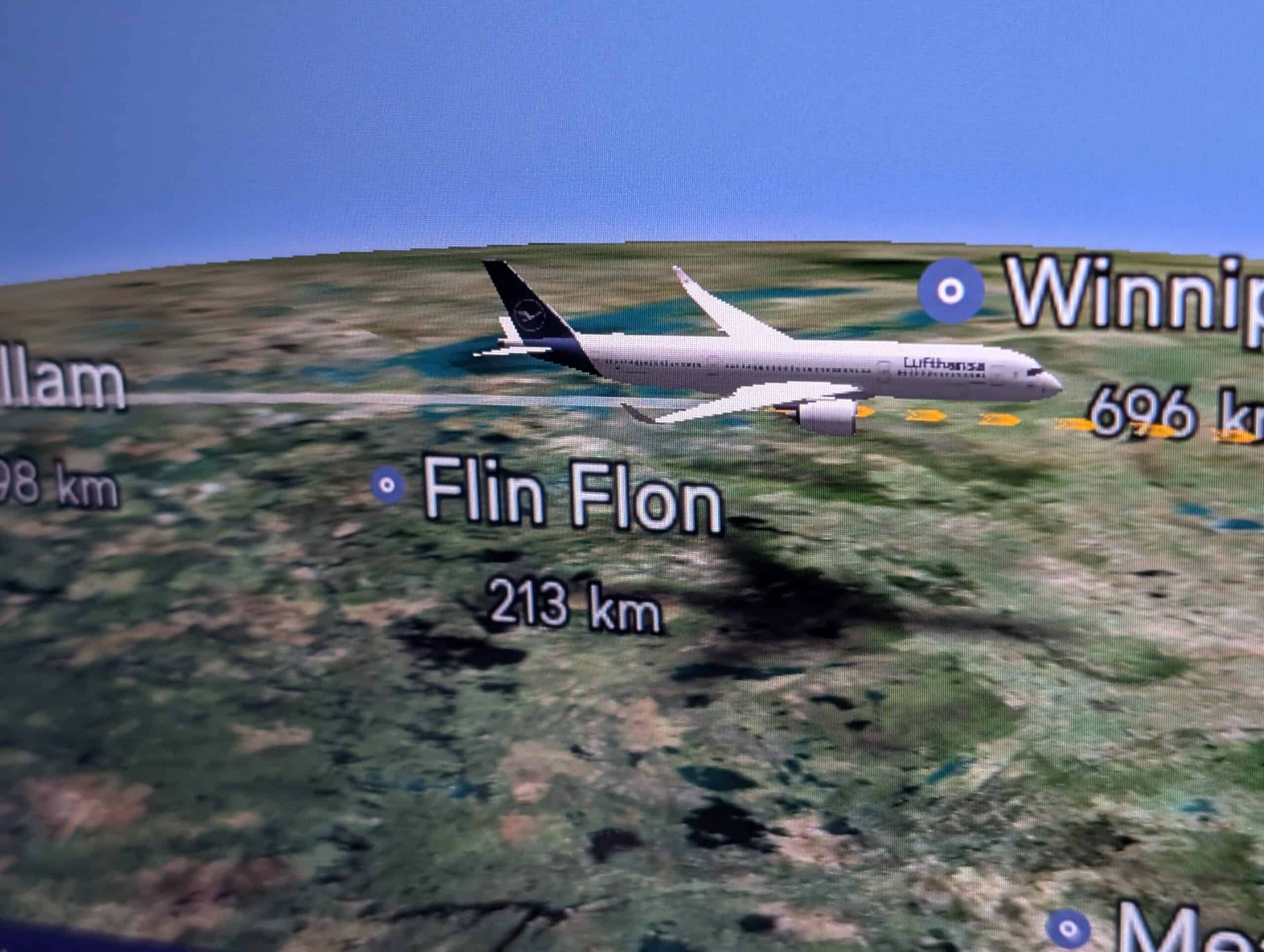
A nonstop flight from Germany usually takes around 11 to 12 hours. The flight back to Europe is often a little shorter because of prevailing winds.
With a connection, total travel time can easily reach 15 or 16 hours or more. If you first need a short flight from a smaller European airport to a major hub, your travel day can be even longer.
That’s why I wouldn’t compare flights on price alone. Two tickets at almost the same price may differ significantly in connection times and total journey length.
Nonstop Flight or Connection?
If the price and schedule work, a nonstop flight is naturally the most comfortable option.
Connecting flights can be noticeably cheaper and, depending on your departure airport, may be practical or unavoidable. What matters is not just where you connect, but how much time you have.
I like using Google Flights or KAYAK to compare schedules and prices. Whenever possible, I then book directly with the airline. It’s often easier if you later need help changing flights, handling baggage, or reserving seats.
Personally, I’ve had excellent experiences connecting through Frankfurt and Munich with Lufthansa, and through Zurich with SWISS. I’ve also heard plenty of positive feedback from other travelers and guests about KLM via Amsterdam and Air France via Paris.
British Airways via London is another interesting option. For a purely airside connection, where you stay within the transit area and do not pass UK border control, you currently do not need a UK Electronic Travel Authorisation (ETA). If you need to enter the UK during your connection, you may need a UK ETA, depending on your nationality. Check the rules and your specific connection with your airline before booking.
What Should I Know About Connecting Flights in the US?
If your first US airport is Chicago, Dallas, or Atlanta, for example, you will normally clear US immigration there, not at your final destination in Los Angeles.
You’ll pass through immigration and customs before catching your connecting flight. Depending on the airport and itinerary, you may also have to collect your checked luggage and recheck it after clearing customs.
Especially on a first trip to the US, I wouldn’t book a connection with a very short layover. Two to three hours feels far more comfortable to me than an itinerary where one long immigration line could cause you to miss your flight.
If you connect in Frankfurt, Munich, Zurich, Amsterdam, or Paris and then fly nonstop to Los Angeles, you normally clear US immigration at LAX instead.
What Questions Will I Be Asked at US Immigration?
When entering the United States, a CBP officer will usually ask a few short questions about your trip. That’s normal and no reason to panic. Just stay calm, be friendly, and answer truthfully.
The exact questions vary, but some come up regularly. Knowing what they sound like can make the arrival process less stressful, especially if English isn’t your first language.
- What is the purpose of your trip?
I’m here on vacation. - How long are you staying in the United States?
I’m staying for two weeks. - Where are you staying?
I’m staying at a hotel in Los Angeles. - When are you flying back?
I’m flying back to Germany on September 15. - How much money are you carrying with you?
I have about 300 dollars in cash and I also have credit cards.
You don’t have to memorize these answers. The examples simply show how brief and straightforward your responses can be.
If you’re spending two weeks vacationing in Los Angeles, there’s no need for a long explanation. To “What is the purpose of your trip?”, a simple “I’m here on vacation.” is enough.
It’s also helpful to have the name or address of your first hotel and the date of your return flight handy, so you don’t have to search for them at the counter.
And if you don’t understand a question, that’s okay too. Just ask the officer to repeat it: “Could you please repeat that?”
Can I Use Mobile Passport Control (MPC) When Entering the US?
If you’ve visited the United States before, take a look at the free Mobile Passport Control (MPC) app from CBP. It’s available for iPhone and iPad and Android.
MPC lets you submit some arrival information through your phone and may allow you to use designated MPC processing lanes at participating airports, including LAX.
There’s an important restriction for travelers under the Visa Waiver Program: CBP officially lists returning VWP travelers with an approved ESTA as eligible. If this is your first visit to the US, don’t count on being able to use MPC, even if the app lets you enter your information.
MPC does not replace ESTA or the actual immigration inspection. Whether it saves you time depends on the airport, crowd levels, and whether the MPC lane is open.
Is Carry-On Luggage Enough, or Do I Need a Checked Bag?
That depends mainly on how long you’ll stay and whether you can do laundry. If you’re visiting friends and have access to a washing machine, carry-on luggage may be plenty for a regular LA trip.
It can also save quite a bit of money, since checked bags aren’t always included in cheaper fares. The exact allowance depends on your airline and ticket type.
From my experience, round-trip flights from smaller German airports such as Hannover or Hamburg, connecting through Munich to Los Angeles, were often around €650 with carry-on only versus about €790 with a checked bag in mid-2026. Airfares fluctuate considerably, of course, but these figures offer a rough example for European travelers.
If you’re traveling longer or won’t have access to laundry, you may still need a large suitcase and should budget accordingly. If a carry-on is enough, saving €100 or more can be surprisingly easy.
What Is the Time Difference?
Germany and Los Angeles are normally nine hours apart. When it’s 6 PM in Germany, it’s usually 9 AM in Los Angeles. The difference varies depending on where you’re traveling from.
Around daylight saving time changes, the difference with Europe can briefly shift because the US and European countries don’t change their clocks on the same weekends.
For calls home to Germany, nine hours is a useful rule to remember. Early morning in LA is late afternoon or early evening in Germany.
How Bad Is Jet Lag?
Interestingly, I and many of my guests have found the nine-hour difference between Germany and the US West Coast easier to handle than the six-hour difference with the East Coast.
That’s not a universal rule, of course. Everyone reacts differently to time changes.
Flying west to California, you’re effectively following the day. You’ll often arrive on the same calendar day, and it helps to stay awake until a reasonably normal local bedtime that first evening.
For the first few mornings, you might find yourself wide awake at 4 or 5 AM. That doesn’t have to be a bad thing. It’s a wonderful opportunity to enjoy the early hours before Los Angeles really wakes up.
Arriving in Los Angeles

How Do I Get from LAX to My Hotel?
You have several options: a rental car, Uber, Lyft, a taxi, or public transportation with LA Metro.
The best choice depends heavily on where you’re staying. Santa Monica may call for a different solution than Hollywood, Downtown, or Anaheim.
If you’re using Uber, Lyft, or a taxi, don’t assume you’ll be picked up right outside your terminal. LAX has a designated pickup area called LAX-it near Terminal 1. You can walk there from some terminals or take a free shuttle.
If you’ve booked a rental car, you’ll currently need to take a shuttle bus from your terminal to the LAX Rental Car Center. The new SkyLink, formerly known as the Automated People Mover, will eventually connect the terminals directly to the Rental Car Center and the LAX/Metro Transit Center. According to the latest projections, passenger service isn’t expected to begin before February 2027. An official opening date has yet to be confirmed.
The LAX/Metro Transit Center already connects to Metro and several bus routes. Depending on your hotel, public transit may cover much or even all of your journey. Until SkyLink opens, shuttles continue to run between the terminals and the Transit Center.
One thing you definitely shouldn’t expect: stepping off the plane and being in a rental car or on Metro ten minutes later. Allow at least an hour to an hour and a half for immigration, baggage, and getting on your way. It can take longer when the airport is busy.
Do I Need a Rental Car in Los Angeles?
No, but having one can be very convenient.
If you’re staying in Santa Monica and mainly want to explore Santa Monica, Venice, Downtown, or Hollywood, you can manage quite a bit without a car. Metro, buses, Uber, and Lyft can all be good alternatives depending on the route.
A car becomes more useful for Malibu, multiple destinations far apart, or day trips outside the city. But remember to factor in hotel and attraction parking fees, plus the time it can take to find a space.
What many of my guests underestimate isn’t the distance but the driving time. A car gives you more flexibility, but it doesn’t automatically get you from A to B quickly.
So here’s another of my essential Los Angeles travel tips: Make decisions based on drive times and your destinations, not mileage alone.
And if you’d rather skip freeways, route planning, and searching for parking on vacation, you can always spend a day exploring with one of my guided Los Angeles tours.
→ More advice about driving in Los Angeles
Is Public Transportation in Los Angeles Really That Bad?
No. But LA is enormous, and that’s the key point.
Metro rail and buses work very well for some trips. For other destinations, public transit takes much longer than driving or requires several transfers. It pays to consider your hotel location together with the places you want to see.
A regular ride on LA Metro currently costs $1.75. Transfers within two hours are free. With fare capping, you pay no more than $5 per day or $18 within seven days when using the same payment method.
Since mid-2026, things have become easier for visitors: A TAP card is no longer essential. You can tap a contactless debit or credit card, Apple Pay, or Google Pay directly at the reader.
LA’s public transit challenge isn’t that there’s no system. It’s the enormous area the system has to cover.
→ More detailed information about public transportation in Los Angeles
Understanding Los Angeles

Is Downtown the Center of Los Angeles?
Not in the way you might expect from a European city.
Los Angeles doesn’t have one single center that everything else revolves around. Downtown is an important center, but Hollywood is another. Santa Monica has its own downtown, and many other neighborhoods and cities have their own hubs.
If you try to understand LA using the layout of Berlin, Hamburg, or Munich as your model, you’ll get frustrated pretty quickly.
It makes far more sense to think of LA as a huge network of different centers and neighborhoods. Once you see it that way, planning your days becomes much easier.
And if you visit Downtown, don’t stay only among the skyscrapers. Olvera Street, for example, is one of the city’s most historically interesting places.
→ Discover Olvera Street and the Mexican heart of Los Angeles
Are Beverly Hills, West Hollywood, and Santa Monica Part of LA?
Part of Los Angeles County? Yes. Part of the City of Los Angeles? No!
Beverly Hills, West Hollywood, Santa Monica, Culver City, Burbank, and many others are independent cities. In between are neighborhoods that actually belong to the City of Los Angeles.
For your vacation, those municipal boundaries usually don’t matter much. Often you won’t even notice when you cross from one city into another.
But they help explain some of the region’s apparent confusion, including different parking regulations, police departments, and sales tax rates.
How Do I Convert US Measurements?
In the United States, you’ll see miles, gallons, and Fahrenheit everywhere. A few simple shortcuts are enough for vacation planning.
1 mile is about 1.6 kilometers, so 10 miles is roughly 16 kilometers.
1 US gallon is about 3.8 liters.
At the gas station, you can round that up to 4 liters per gallon for a quick mental estimate.
For temperature, the exact conversion is: °C = (°F − 32) × 5 ÷ 9.
That’s a bit of a headache to calculate in your head, so I usually use a simpler shortcut:
Subtract 30 from °F, then divide by 2.
It works surprisingly well at moderate temperatures. At higher temperatures, the result comes out a little low. Above about 80°F, add roughly 1°C; above about 95°F, add around 2°C.
A few reference points are easy to remember:
- 50 °F ≈ 10 °C
- 60 °F ≈ 16 °C
- 70 °F ≈ 21 °C
- 80 °F ≈ 27 °C
- 90 °F ≈ 32 °C
- 100 °F ≈ 38 °C
After a few days, you’ll probably stop converting every number. Eventually you just know: 70°F feels pleasant, 80°F is warm, 90°F is hot, and at 100°F you might not want to hike through the Valley at noon.
Why Should I Think in Minutes, Not Miles, in Los Angeles?
Because ten miles tells you almost nothing about how long the trip will take.
Ten miles is about 16 kilometers. That drive might take 15 or 20 minutes at one time of day and 45 minutes or more just a few hours later.
When planning, I look not only at the distance but also the time of day, direction of travel, and traffic. That combination often determines whether two destinations make sense on the same day.
This is one of the things my first-time LA guests consistently underestimate. Everything looks surprisingly close on a map. But you plan Los Angeles in driving time, not miles.
Getting Around Los Angeles
When Is Rush Hour in Los Angeles?
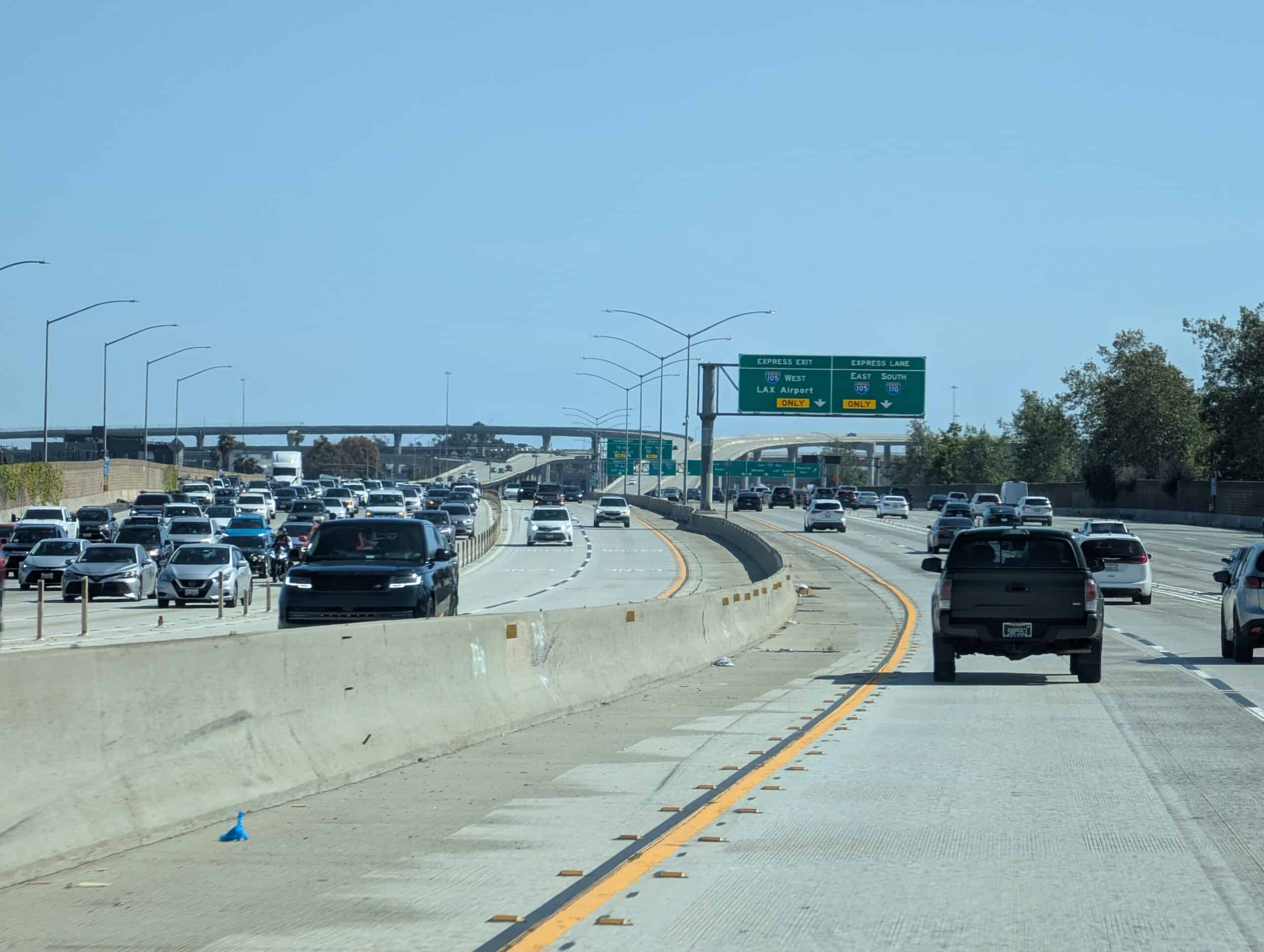
LA certainly has busy commuting periods. As a rough guide, expect especially heavy traffic from about 6:30 to 10 AM and from around 3 to 7 PM.
But the more practical answer is: You should expect traffic in Los Angeles almost all the time!
A freeway accident, concert, sporting event, or just heavy demand can make a trip much longer at any time. Even on weekends, “not rush hour” doesn’t automatically mean empty roads.
I prefer allowing some breathing room instead of planning every minute perfectly. If Google Maps estimates a 35-minute drive, I wouldn’t schedule an appointment exactly 35 minutes later.
How Should I Plan My Days in LA?
By area, not by attraction!
Santa Monica and Venice work well together. Malibu fits naturally into a coastal day. Hollywood and Griffith Observatory also make sense as a pair.
A much less practical itinerary would be:
Malibu → Downtown → Hollywood → Santa Monica.
That looks like just four points on a map. In reality, it can turn into an impressive amount of freeway driving, with much of your vacation day spent looking through a windshield.
One of my most useful Los Angeles travel tips is to put your attractions on a map first, then build each day around a specific part of the city.
→ Santa Monica or Venice Beach: Relaxed, crazy, or a little of both?
Can I See All the Major LA Attractions in One Day?
You can pack a lot into one day. The more interesting question is: Would you actually enjoy that vacation?
Checking off the Hollywood Sign, Walk of Fame, Beverly Hills, Santa Monica, Venice, Griffith Observatory, Downtown, and Malibu in one day might be theoretically possible. But you wouldn’t really get to experience much at any of those places.
I often find that my guests’ plans before arriving are far more ambitious than their plans after their first real day in LA. Once you’ve experienced the distances and traffic for yourself, the next day’s list tends to get shorter all on its own.
I’d rather choose fewer places and actually spend some time there.
And if Hollywood is already on your itinerary:
→ My favorite places to photograph the Hollywood Sign
→ Five fun facts about the Hollywood Walk of Fame
How Does Parking Work in Los Angeles?
The most important rule is simple: Read every sign!
Street cleaning schedules, time limits, permit-only parking, and colored curbs can all determine whether you’re allowed to park. Sometimes several signs apply to the same spot at different times of day.
Curb colors offer more clues. Red generally means no stopping; green usually indicates short-term parking; blue marks spaces reserved for eligible disabled parking permits. White and yellow zones are generally intended for passenger pickup/drop-off or loading, subject to posted rules.
Unfortunately, an empty parking space doesn’t necessarily mean you’re allowed to use it. When in doubt, read all the signs before you leave the car.
For the official rules on colored curbs, check the Los Angeles Department of Transportation.
Money and Everyday Life
Do I Need Cash in Los Angeles?
Very little.
Credit cards and contactless payments are accepted almost everywhere in Los Angeles. Even small purchases are usually easy to pay for by card or phone. A little emergency cash is still useful.
More important is a credit card that works reliably in the United States! Hotels and rental car companies often place a temporary security hold on your card.
I also wouldn’t rely on a single payment option. A second card, stored separately, can be a lifesaver if one is lost, blocked, or simply not accepted.
And LA doesn’t have to be nearly as expensive as its reputation suggests:
→ Ways to enjoy Los Angeles on a budget
Why Does Everything Cost More at Checkout Than on the Price Tag?
Because sales tax is usually added at checkout.
In the City of Los Angeles, the sales tax rate is currently 10.25%, while Santa Monica, for example, has a rate of 11.25%. Rates can vary from city to city within the greater LA area.
So an item with a $100 price tag that is subject to sales tax would cost about $110.25 in the City of Los Angeles.
For visitors from many European countries, this can feel strange at first because value-added tax is normally already included in the displayed price back home. After a few shopping trips, you’ll barely notice the difference.
You can check current rates with the California Department of Tax and Fee Administration.
How Much Should I Tip in Los Angeles?
At a full-service restaurant, 18-20% is a useful guideline. For exceptional service, you can leave more.
At bars, $1–$2 per drink is common. For taxis, Uber, or Lyft, around 10–20% can be reasonable depending on the service.
Before tipping at a restaurant, take a quick look at the bill. Especially for larger parties or at some tourist-oriented restaurants, gratuity or a service charge may already be included. You don’t want to accidentally add the full tip twice.
And here’s a difference from places such as Germany: Simply rounding up by a few dollars, which is common in some European countries, might be far too little on a larger US restaurant bill. A percentage is the easiest guide.
Safety
Is Los Angeles Dangerous?
Los Angeles is an enormous metropolitan area, so describing the entire place as simply “safe” or “dangerous” doesn’t make much sense.
Some areas feel very quiet; in others, I’d pay more attention, especially at night. The atmosphere can change within just a few blocks. As in any big city, stay aware of your surroundings and move on if something doesn’t feel right.
Many of my guests are initially surprised by the visible homelessness. It can feel unfamiliar or uncomfortable, but it doesn’t automatically mean you’re in immediate danger.
One rule I would follow everywhere: Never leave valuables visible in a parked car. Bags, cameras, and laptops don’t belong on the seat, not even “just for five minutes”!
Should I Worry About Earthquakes?
No. But it does make sense to know roughly what to do if a stronger earthquake occurs.
In California, people often say: “It’s not a question of if the next earthquake will happen, but when.” That sounds more dramatic than everyday life is for most visitors. Most earthquakes are so small that you won’t notice them, or nothing much happens.
Rather than spending your vacation waiting for an earthquake, take a few minutes to learn what to do and then get on with your trip. Ready.gov has a useful overview.
The same goes for wildfires. Especially during hot, dry periods, take official alerts and road closures seriously. But there’s no reason to spend an ordinary vacation constantly expecting something to happen.

What Wildlife Might I Encounter Around Los Angeles?
There’s more wildlife in and around Los Angeles than many visitors expect. Mountain lions and black bears live in Southern California, although encounters with tourists are very rare.
If you’re hiking in more remote areas, making a bit of normal noise, such as talking with your companions or using hiking poles, can help avoid surprising wildlife.
Coyotes are much more common. You may even see them in neighborhoods and parks. Don’t feed them, keep your distance, and never leave small pets unattended. If a coyote approaches unusually closely, make yourself look bigger and make loud noises.
You may also come across rattlesnakes while hiking. Stay on established trails where possible, don’t reach blindly between rocks or into bushes, and always give snakes plenty of space.
For more detailed wildlife safety advice, visit the California Department of Fish and Wildlife.
At the beach there’s another animal visitors sometimes forget about: stingrays. In shallow water, use the so-called “stingray shuffle,” sliding your feet through the sand rather than taking big steps. That usually encourages rays to move away before you accidentally step on one.
What Are My Most Important Los Angeles Travel Tips?
Don’t try to explore Los Angeles as if it were a European city.
There isn’t one single downtown, one kind of weather, or one landmark you can visit and then say you’ve “seen Los Angeles.”
And don’t let people discourage you by saying two days are plenty and LA isn’t especially beautiful or interesting anyway. Someone who spent a short time here, ticked off a few famous sights, and moved on has often seen only a tiny piece of the city. That’s where many of those sweeping judgments come from.
Los Angeles doesn’t always reveal itself at first glance. The city needs a little time. Many of its most interesting sides are between the famous landmarks: in individual neighborhoods, along the coast, up in the hills, or somewhere you never planned to stop at all.
→ Los Angeles has its ugly sides. And somehow, I like those too…
So group your days by location, leave a little room in your schedule, and don’t underestimate driving times.
And perhaps most importantly: Leave room for things that weren’t on your list in the first place.
Some of my favorite memories from my own trips to LA happened in exactly those unexpected places. Today, as a tour guide, I see my guests having similar experiences again and again.
In my opinion, Los Angeles becomes far more interesting the moment you stop simply checking off attractions and start understanding the city a little.

→ How to avoid being disappointed by Los Angeles
And when the day finally comes to an end:
→ Some of the best places to watch the sunset in Los Angeles
